Introduction
When you’re like me, tax season in all probability doesn’t spark pleasure. It’s complicated, overwhelming, and infrequently looks like a transferring goal. Simply whenever you suppose you’ve bought it found out, Congress adjustments the foundations once more. That’s precisely the place we discover ourselves in 2025 with the One Big Beautiful Bill Act (OBBBA)—a sweeping tax bundle that was signed into legislation on July 4, 2025. So, what are these OBBBA Tax Changes 2025? We’ll get to know in a minute.
Once I first began studying about OBBBA, I’ll admit, I felt each hopeful and skeptical. Hopeful as a result of some adjustments look genuinely useful for working households like mine. Skeptical as a result of, as all the time, there are hidden complexities—and never everybody goes to profit equally.
On this submit, I’ll stroll you thru:
- What the OBBBA truly is (with out the political jargon).
- Key tax adjustments for 2025 and past.
- The real-world influence on people, households, seniors, and high-net-worth households.
- Planning methods you should use in the present day so that you’re not caught off guard when submitting subsequent yr.
- The trade-offs nobody actually talks about—like cuts to Medicaid and federal deficits.
My aim isn’t simply to repeat what’s already on monetary information websites. As a substitute, I need you to understand and get honest information. As a result of let’s face it—these legal guidelines don’t reside on paper. They have an effect on how we finances, save, increase our youngsters, and even plan for retirement.
Table of Contents
What Is the One Big Beautiful Bill Act (OBBBA)?
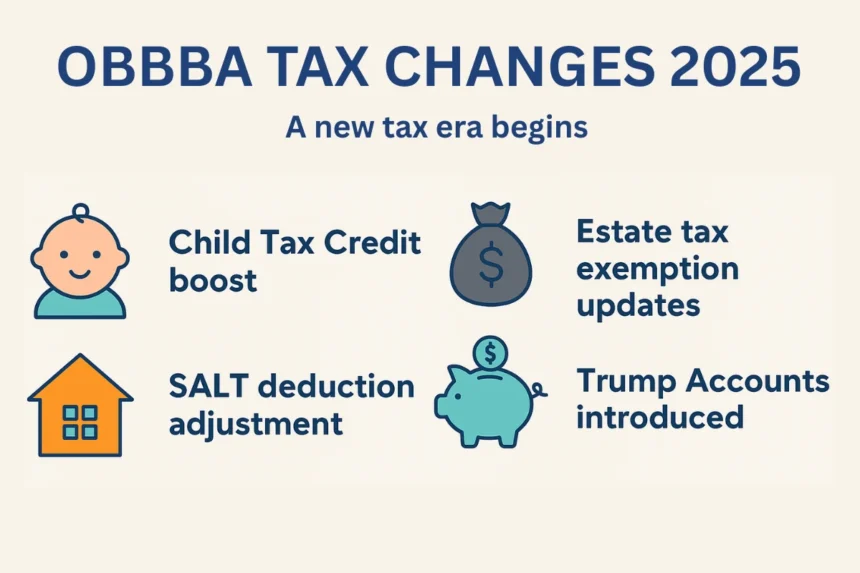
The OBBBA is a huge tax legislation that locks in lots of provisions from the 2017 Tax Cuts and Jobs Act (TCJA) and introduces a bunch of recent guidelines. Consider it as a “ceaselessly extension” of the Trump-era tax cuts—solely with extra layers sprinkled in for employees, households, seniors, and companies.
A number of the highlights embrace:
- Making everlasting the seven particular person tax brackets (10% by way of 37%).
- Expanded normal deductions however no return of non-public exemptions.
- Youngster tax credit score will increase and adoption credit score expansions.
- New deductions for time beyond regulation pay, ideas, and even auto mortgage curiosity.
- Property tax exemption soar beginning in 2026 ($15 million per particular person).
- Introduction of quirky however probably highly effective “Trump Accounts” to assist youngsters with schooling, housing, and even entrepreneurship.
Sounds good up to now, proper? However right here’s the catch: not everybody qualifies, some advantages expire before you suppose, and a number of other “hidden prices” will present up in different areas like healthcare applications.
Why 2025 Is a Turning Level
This year is particular as a result of many TCJA provisions have been set to expire on the finish of 2025. As a substitute of letting them vanish, OBBBA locks them in completely.
Meaning:
- Decrease tax charges are right here to remain.
- Normal deduction stays bigger, making itemizing much less widespread.
- Private exemptions (as soon as a key deduction for households) are gone for good.
When you’re planning your taxes for 2025, this legislation is not optionally available background noise. It immediately shapes what you’ll owe or save.
Main 2025 Tax Modifications Beneath OBBBA
1. Tax Brackets Keep the Identical—With a Twist
The seven earnings tax brackets stay (10%, 12%, 22%, 24%, 32%, 35%, 37%), however with inflation changes beginning in 2026. That appears like stability, however if you happen to’re anticipating the IRS to decrease your paycheck withholding instantly—suppose once more.
Right here’s what most individuals don’t notice: The IRS is not updating withholding tables for 2025. Meaning your paycheck might look precisely the identical this yr, despite the fact that you’ll technically owe much less whenever you file in 2026.
👉 Translation: You possibly can be sitting on an sudden refund—or worse, underpaying with out realizing it.
My tip: Examine your withholding manually. Don’t assume your employer’s payroll system is aware of what’s greatest.
2. Greater Normal Deduction, No Private Exemptions
For 2025, the usual deduction will increase once more:
- $15,750 – Single or Married Submitting Individually
- $23,625 – Head of Family
- $31,500 – Married Submitting Collectively
That’s a win for simplicity. However the everlasting elimination of non-public exemptions hits bigger households tougher. For households with a number of dependents, the maths doesn’t all the time really feel truthful.
I keep in mind when exemptions helped cut back our taxable earnings for every little one—it felt tangible. Now, whereas the little one tax credit score helps, some households will nonetheless really feel like they’ve misplaced floor.
3. New Deductions for Staff: Extra time, Suggestions, and Auto Loans
Right here’s the place issues get attention-grabbing. OBBBA permits deductions for:
- Extra time pay
- Suggestions
- Auto mortgage curiosity
It sounds superb, however don’t have a good time too quickly. In keeping with consultants, lower than 9% of taxpayers will truly qualify for the time beyond regulation/ideas deduction. Why? As a result of the thresholds and restrictions reduce most individuals out.
Nonetheless, if you happen to work hourly with vital time beyond regulation or rely closely on ideas, this might be a uncommon likelihood to see significant tax aid.
My recommendation: Preserve detailed pay stubs and auto mortgage statements—these deductions would require hermetic proof.
4. Youngster and Adoption Credit Get Greater

The kid tax credit score will increase by $200 per little one completely. Adoption credit are actually partially refundable, which is big for households going by way of the already costly adoption course of.
As a mother or father, I see this as a small however actual win. Further {dollars} at tax time assist offset rising childcare and schooling prices—even when they don’t absolutely cowl them.
5. 529 Plans and Training Flexibility
Households can now use 529 plan withdrawals for Ok-12 bills, not simply faculty. Meaning tuition for personal elementary, highschool, and extra.
This looks like sensible aid, particularly for fogeys juggling rising college prices earlier of their youngsters’s lives.
6. Trump Accounts: A New Financial savings Car
This one caught my consideration. Beginning with youngsters born 2024 by way of 2028, the federal government will seed $1,000 right into a “Trump Account”—a tax-deferred financial savings plan. Mother and father and family members can contribute, and funds can be utilized later for:
- Training
- Shopping for a primary dwelling
- Beginning a enterprise
It’s an odd title, but when managed properly, this might grow to be a worthwhile useful resource for youthful generations. The main points are nonetheless fuzzy, although, and critics argue many households received’t contribute sufficient to make it impactful.
7. Property and Reward Tax Exemptions
From 2026 onward, the property and present tax exemption jumps to $15 million per particular person ($30 million for {couples}), listed for inflation.
When you’re a high-net-worth family, this can be a once-in-a-lifetime planning window. I’ve already heard property attorneys urging purchasers to replace trusts, contemplate gifting methods, and lock in advantages earlier than any political reversal.
For many of us, this may increasingly really feel irrelevant. However even middle-class households who’ve seen property values soar ought to no less than revisit their property plans.
8. SALT Deduction Growth
The State and Native Tax (SALT) deduction cap expands as much as $40,000 by way of 2029. After that, it reverts again to $10,000.
For households in high-tax states (California, New York, New Jersey), that is vital respiration room. However it’s non permanent, so it’s greatest to maximise whereas it lasts.
9. The Social Commerce-Off: Medicaid and Past
Right here’s the aspect nobody likes to speak about. To pay for these tax breaks, OBBBA makes deep cuts to Medicaid and SNAP applications. In keeping with projections, tens of millions of low-income households might lose protection.
That actuality is sobering. Whereas many people might profit from deductions or credit, others are paying the worth in decreased healthcare entry.
As somebody who believes in each monetary alternative and equity, I can’t ignore this aspect of the story. Tax legal guidelines form society—and OBBBA will go away winners and losers.
Tax Planning Suggestions for 2025
Alright, let’s get sensible. What must you truly do this yr? Mark your calendar for tax deadlines, and hold thorough data of:
Maximize Deductions
- Preserve auto mortgage curiosity documentation organized.
- Observe ideas and time beyond regulation individually.
- Consider whether or not itemizing beats the bigger normal deduction.
Leverage Credit
- Run the numbers on the brand new little one tax credit score.
- If adopting, don’t neglect the refundable adoption credit score.
- Discover 529s and Trump Accounts early.
Property Planning Strikes
- Excessive-net-worth households ought to act earlier than 2026.
- Think about belief updates and lifetime gifting now.
Withholding Examine
- Don’t assume your paycheck displays new legislation adjustments.
- Use IRS calculators or seek the advice of a tax skilled to keep away from surprises.
Getting ready for Tax Submitting in 2025
Right here’s my private guidelines:
- W-2s, 1099s (with time beyond regulation/ideas clearly marked).
- Auto mortgage statements.
- Training receipts and 529 withdrawal data.
- Childcare and adoption expense receipts.
- Contribution proof for Trump Accounts or trusts.
And don’t underestimate the worth {of professional} steering. Software program is nice, however OBBBA is sophisticated. Typically a human CPA is price the associated fee.
Closing Ideas
The One Big Beautiful Bill Act is each stabilizing and disruptive. It locks in decrease taxes for a lot of, nevertheless it additionally reshuffles the enjoying area—typically in ways in which don’t really feel truthful.
As I sit with my family’s numbers, I see alternatives: greater deductions, expanded credit, long-term property planning strikes. However I additionally see gaps: advantages that solely apply to a sliver of taxpayers, looming Medicaid cuts, and a nationwide debt that my youngsters will at some point inherit.
Taxes aren’t nearly numbers. They’re about priorities, trade-offs, and the way a rustic decides to share its assets. My hope is that by understanding OBBBA deeply—not simply skimming the headlines—we are able to make smarter selections for ourselves and advocate for insurance policies that stability each alternative and equity.