
Region: India | Level: Intermediate | Content Type: Regulatory Education | Last Reviewed: August 2026
The SEBI MF-Lite Framework is a lighter regulatory regime for passive mutual funds in India. SEBI first introduced it through a circular on December 31, 2024, and it became effective on March 16, 2025. In April 2026, SEBI folded the framework into the new SEBI (Mutual Funds) Regulations, 2026. It reduces entry barriers for fund houses that run only passive schemes like index funds, ETFs, and fund-of-funds. It replaces the traditional trustee company with a debenture trustee. It also lowers capital requirements for new sponsors. For investors, the SEBI MF-Lite Framework may lead to more passive fund choices and competitive expense ratios over time. It does not remove market risk or guarantee lower fees.
Understanding the framework requires looking at three dates.
December 31, 2024: SEBI issued a circular introducing the SEBI MF-Lite Framework for passive schemes. This was the first formal notification.
March 16, 2025: The framework became effective. Fund houses could start registering under this lighter regime.
April 1, 2026: The SEBI (Mutual Funds) Regulations, 2026 came into force. These new regulations replaced the 1996 rules. They folded the SEBI MF-Lite Framework and the Specialized Investment Fund (SIF) into the main law. The framework did not start in 2026. It was already running. The 2026 regulations simply gave it a permanent place in the rulebook.
Existing schemes did not need relaunching. All registrations and schemes continued under the new law.
The SEBI MF-Lite Framework creates a separate category of mutual fund. It is designed only for passive products. A fund house operating under this regime can launch index funds, exchange-traded funds (ETFs), fund-of-funds (FoFs), and other passive schemes. It cannot launch active funds.
The “Lite” part refers to lighter compliance and governance requirements compared to a regular mutual fund. For example, the framework allows a debenture trustee instead of a full trustee company. This reduces infrastructure costs.
However, lighter regulation does not mean weaker investor protection. The 2026 regulations added new safeguards across all mutual funds. These include mandatory whistleblower policies, a unit-holder protection committee, and a 21-day deadline for resolving investor complaints.
If you are new to passive investing, you may want to read our guide on what is an ETF first. It explains the basics of exchange-traded funds in plain English.
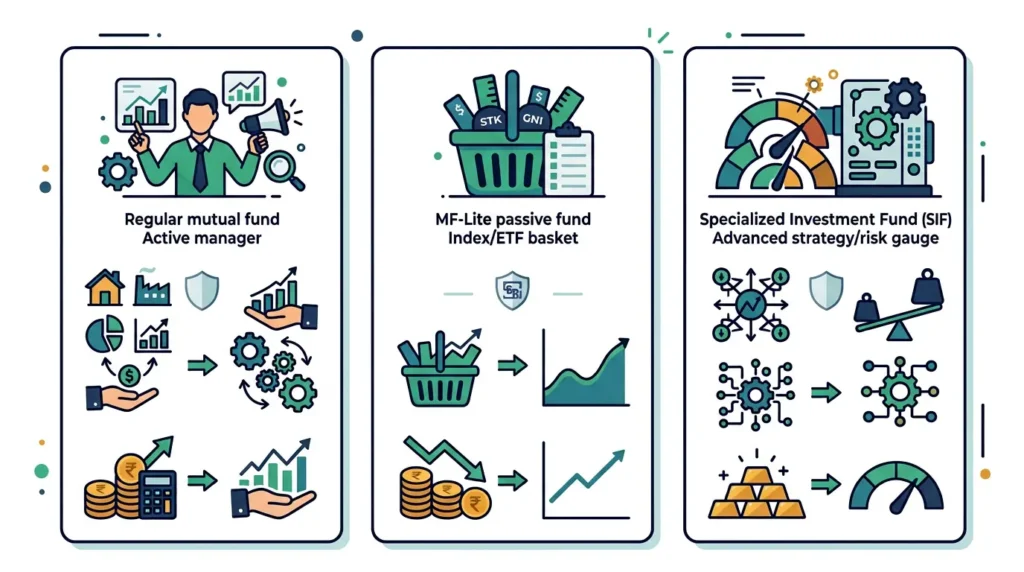
The 2026 regulations created three categories of mutual funds. Here is how they differ under the SEBI MF-Lite Framework compared to other structures.
Table
| Feature | Regular Mutual Fund | SEBI MF-Lite Framework | Specialized Investment Fund (SIF) |
|---|---|---|---|
| Fund types allowed | Active and passive | Passive only (index, ETF, FoF) | Higher-risk strategies (long-short, derivatives) |
| Trustee structure | Trustee company | Debenture trustee | Trustee company |
| Sponsor capital (Route 1) | Standard requirements | Rs 35 crore initially; Rs 25 crore after 5 profitable years | Standard requirements |
| Sponsor capital (Route 2) | Rs 150 crore initial; Rs 75 crore lock-in for 5 years | Rs 75 crore initial; Rs 50 crore maintained; Rs 25 crore after 5 years | Rs 150 crore initial; Rs 75 crore lock-in for 5 years |
| Expense ratio cap | Higher for active; 0.90% for index/ETF | Same 0.90% cap for index/ETF | Higher, based on structure |
| Minimum investment | No minimum | No minimum | Rs 10 lakh per PAN |
| Who it suits | General retail investors | Passive-only investors | Sophisticated/accredited investors |
The key difference for everyday investors is this: funds launched under the SEBI MF-Lite Framework will look and behave like regular index funds or ETFs. You buy them the same way. The difference sits behind the scenes in how the fund house is regulated and capitalized.
If you are deciding between an ETF and an index fund, our comparison of ETF SIP vs mutual fund SIP in India breaks down the real cost differences.
SEBI is rolling out the framework in phases. Phase 1 covers specific passive categories. A fund house cannot launch just any passive fund under this regime. It must fit one of these buckets.
These track broad-based domestic equity indices. The index must have a cumulative AUM of at least Rs 5,000 crore as of December 31 of each financial year. SEBI and AMFI will update the list of eligible indices periodically.
These invest in government securities (G-Secs), treasury bills (T-Bills), and state development loans (SDLs). They can also follow constant-duration passive debt indices. The same Rs 5,000 crore AUM threshold applies.
Gold ETFs, silver ETFs, and FoFs that invest exclusively in these ETFs qualify. These give investors exposure to precious metals without holding physical metal. If you want to understand gold ETFs better, read our guide on gold ETF vs silver ETF in India.
ETFs and FoFs that invest in a single overseas passive fund can qualify. The underlying index must meet the framework’s requirements. Overseas equity passive schemes must track broad-based indices with at least 10 securities and a minimum AUM of $20 billion as of December 31 each year.
FoFs that invest exclusively in a single domestic or overseas index qualify. However, FoFs that invest in multiple indices do not qualify under Phase 1.
The SEBI MF-Lite Framework also allows hybrid passive funds that combine equity and debt exposure. SEBI has defined three categories:
Table
| Category | Equity : Debt Split |
|---|---|
| Debt-oriented | 25 : 75 |
| Balanced | 50 : 50 |
| Equity-oriented | 75 : 25 |
Each fund house can launch only one hybrid fund per category initially. The minimum initial investment for the New Fund Offer (NFO) is Rs 10 crore. The fund must rebalance to the target allocation at the end of each calendar quarter.
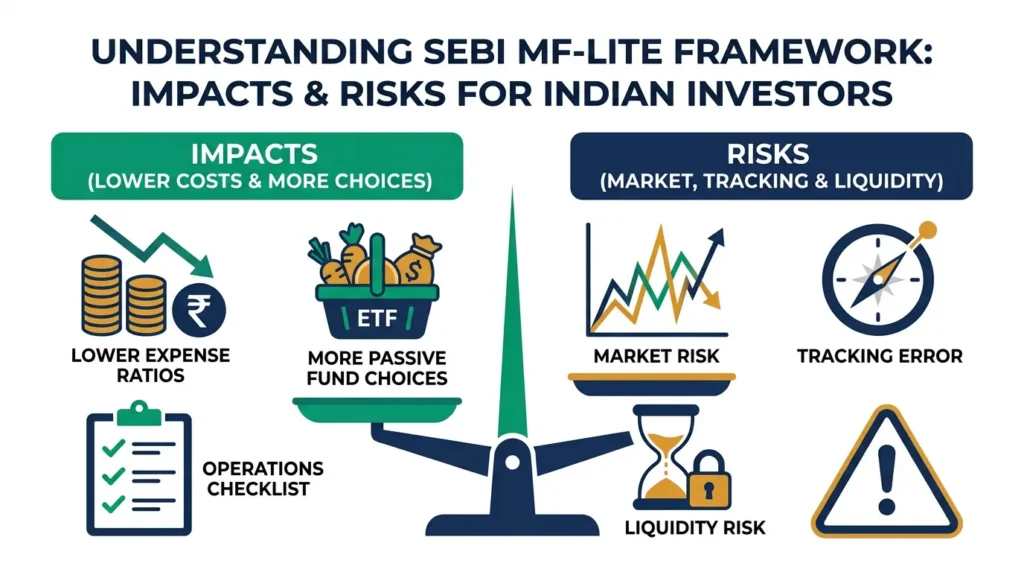
The framework may change the passive fund landscape in India. Here is a realistic look at what could happen and what will not.
The SEBI MF-Lite Framework lowers the capital and compliance burden for new entrants. This could bring new fund houses into the passive space. More competition often pushes expense ratios down. However, SEBI has not mandated lower fees. The expense ratio cap for index funds and ETFs remains 0.90% under the 2026 regulations. Whether fees drop depends on market competition, not regulation alone.
To see how fees affect your long-term returns, try our free ETF compounding calculator.
The framework allows hybrid passive funds and more overseas ETF options. Investors may see new products that blend equity and debt in a single passive wrapper. This could simplify portfolio building for some investors.
The SEBI MF-Lite Framework does not change the nature of passive investing. Index funds and ETFs still track the market. If the market falls, these funds fall too. Tracking error still exists. Liquidity risk still exists for thinly traded ETFs. The framework changes how fund houses operate. It does not change what happens to your money.
If you want to understand tracking error better, read our guide on tracking error explained.
If you already hold index funds or ETFs from established AMCs, you do not need to switch them to funds launched under the SEBI MF-Lite Framework. Existing schemes continue under the new law. The framework mainly affects new fund launches and new entrants.
For equity-oriented passive schemes under this regime, SEBI has set a tracking difference target of 50 basis points over and above the actual TER charged. This means the fund should not lag its benchmark by more than 0.50% plus the expense ratio. This is a target, not a guarantee.
Funds launched under the SEBI MF-Lite Framework face investment restrictions. They cannot invest in:
If an entity operating under the SEBI MF-Lite Framework grows beyond Rs 1 trillion in AUM, it must step up to the regular AMC net worth requirements. This prevents a passive-only giant from operating with lighter rules indefinitely.
New entrants can sponsor an entity under this framework through two routes:
No. The framework does not affect your current index funds or ETFs. Existing schemes continue under the 2026 regulations. You do not need to redeem, switch, or take any action. The SEBI MF-Lite Framework only affects how new fund houses enter the market and how new schemes are launched.
Maybe, but not guaranteed. The framework lowers barriers for new fund houses. More competition could push expense ratios down. However, SEBI has not mandated lower fees. The expense ratio cap remains 0.90% for index funds and ETFs. Whether you pay less depends on which fund houses enter the market and how they price their products.
No. Funds launched under the SEBI MF-Lite Framework will be available through the same channels as regular mutual funds and ETFs. If you buy index funds, you can use your existing mutual fund platform. If you buy ETFs, you still need a demat and trading account. No special account is required.
No. The “Lite” in SEBI MF-Lite Framework refers to lighter regulation for the fund house, not safer investments for you. The underlying risk depends on the index being tracked. An MF-Lite Nifty 50 index fund carries the same market risk as a regular Nifty 50 index fund. Market risk, tracking error, and liquidity risk still apply.
The SEBI MF-Lite Framework is for passive funds only: index funds, ETFs, and fund-of-funds. SIF (Specialized Investment Fund) is for sophisticated strategies like long-short investing and derivatives. SIF requires a minimum investment of Rs 10 lakh per PAN. MF-Lite has no minimum. They serve completely different investor profiles. Most retail investors will interact with MF-Lite products, not SIF.
No. Your broker or mutual fund platform will list MF-Lite funds the same way as regular funds. You will not see a separate “MF-Lite” tab. The fund name may not even mention MF-Lite. The difference is in how the fund house is regulated, not in how the product appears on your screen.
Yes. Once fund houses launch schemes under the SEBI MF-Lite Framework, you can start SIPs in their index funds just like any other mutual fund. For ETFs, SIP-like facilities may be available through brokers, but each instalment counts as a separate trade with brokerage charges. If you prefer simple SIP investing, index funds under the SEBI MF-Lite Framework will work like any other index fund.
No. The SEBI MF-Lite Framework is a regulatory change, not a market event. It does not make existing index funds or ETFs obsolete. If you have a financial plan, stick to it. You can always evaluate new MF-Lite funds when they launch. Waiting for a regulatory change is not an investment strategy. Time in the market matters more than timing the launch of new fund categories.
This article is for educational purposes only. It does not constitute investment, tax, legal, or financial advice. Finzedia does not recommend any specific mutual fund, ETF, or investment strategy. The SEBI MF-Lite Framework is a regulatory structure. It does not guarantee investment outcomes, lower fees, or reduced risk. Rules and product availability change over time. Always read the latest Scheme Information Document (SID), Statement of Additional Information (SAI), and factsheet before investing. Consult a SEBI-registered investment adviser or qualified tax professional for guidance tailored to your situation.