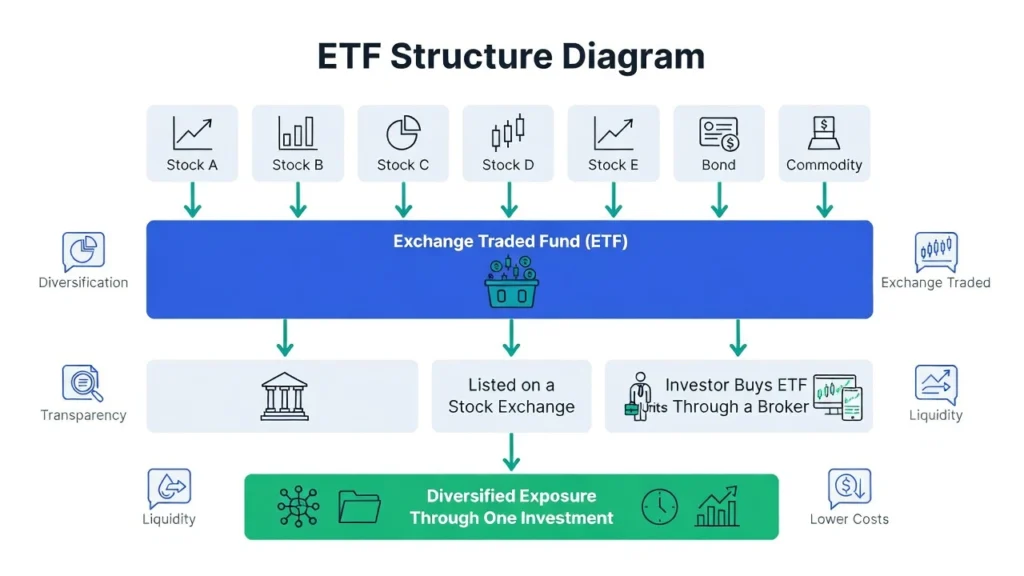
An ETF (Exchange Traded Fund) is a basket of securities that trades on a stock exchange like a single stock. In India, ETFs track indices such as the Nifty 50 or Sensex. You need a demat account and a trading account to invest. ETFs can give diversification like mutual funds, but they trade during market hours like stocks.
SEBI regulates all ETFs in India. If you are not understanding what SEBI is, don’t worry, you will get to know more details through our posts.
An ETF holds a collection of assets. These assets can be stocks, bonds, commodities, or a mix. When you buy one unit of an ETF, you own a small slice of every asset inside that basket.
Think of it like a thali meal at a restaurant. You do not order each dish separately. You get one plate with rice, dal, vegetables, and roti. An ETF works the same way. One purchase gives you exposure to many companies or assets.
In India, the first ETF was NiftyBeES. Nippon India Mutual Fund launched it in January 2002. It tracks the Nifty 50 index. Today, India has over 250 ETFs listed on the NSE and BSE.
SEBI has introduced a newer framework for mutual funds, including a lighter structure for passive products such as ETFs and index funds. Investors should still read the latest scheme documents before investing.
ETFs operate through a unique creation-and-redemption mechanism. An Asset Management Company (AMC) creates the fund. The AMC buys the underlying securities that match an index. Then it lists the ETF units on the stock exchange.
Here is the step-by-step flow:
The price of an ETF should stay close to its Net Asset Value (NAV). The NAV is the total value of all assets inside the fund divided by the number of units. However, the market price can differ slightly from the NAV due to trading activity.
The creation and redemption process helps ETFs keep their market price close to the value of their holdings. For a retail investor, the bigger tax point is simpler: your tax depends on the ETF category, your holding period, and the rules in force when you sell.
The creation and redemption process helps ETFs keep their market price close to the value of their holdings. For a retail investor, the bigger tax point is simpler: your tax depends on the ETF category, your holding period, and the rules in force when you sell.
Many beginners confuse these three products. They are not the same. Here is a clear comparison.
ETF vs Mutual Fund vs Index Fund
| Feature | Active Mutual Fund | Index Fund | ETF |
|---|---|---|---|
| Management | Fund manager picks stocks | Passive — tracks an index | Passive — tracks an index |
| Account Needed | No demat needed | No demat needed | Demat + trading account required |
| Pricing | End-of-day NAV | End-of-day NAV | Real-time market price |
| SIP Option | Yes, easy SIP | Yes, easy SIP | Possible through broker, but brokerage applies per trade |
| Minimum Investment | ₹100–₹500 | ₹100–₹500 | One unit (price varies) |
| Fractional Units | Yes | Yes, up to 4 decimal places | No — whole units only |
| Expense Ratio | 0.50%–1.80% | 0.10%–0.30% | 0.05%–0.20% |
| Trading Costs | None | None | Brokerage + STT + GST + spread |
ETFs and index funds both follow passive strategies. Both track indices. The key difference is how you buy and hold them. ETFs trade on the exchange. Index funds work like regular mutual funds.
For most SIP investors in India, index funds offer more convenience. You do not need a demat account. You do not pay brokerage on every instalment. ETFs suit investors who want intraday trading flexibility or already have a trading account. If you are trying to decide between the two, read our deep dive on ETF SIP vs Mutual Fund SIP in India to see which fits your situation.
India offers ETFs across four main categories. Each serves a different purpose.
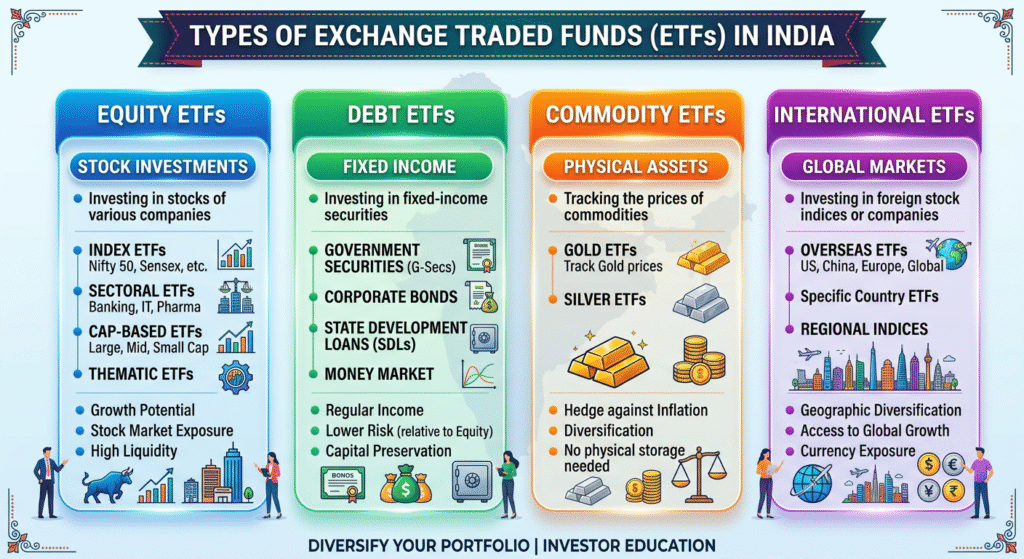
These track stock market indices. Examples include:
These track bond indices. They invest in government securities, PSU bonds, or corporate debt. Debt ETFs offer a lower-risk option compared to equity ETFs. However, they still carry interest-rate risk and credit risk.
These track commodity prices. In India, gold ETFs and silver ETFs are popular. They track the domestic price of physical gold or silver. You do not own the physical metal. You own units that reflect its price movement.
These track global indices. They give you exposure to markets outside India. Examples include ETFs tracking the Nasdaq 100 or Hang Seng Index. These carry currency risk in addition to market risk.
You need two accounts to buy ETFs in India:
You can open both accounts with a stockbroker or a bank that offers broking services. SEBI mandates KYC (Know Your Customer) verification before you can open these accounts.
Submit your PAN card, Aadhaar, proof of address, a cancelled cheque, and a passport-size photograph. Most brokers now offer video KYC, which takes less than 10 minutes.
Choose a SEBI-registered broker. Compare brokerage fees—some brokers now offer zero brokerage on delivery trades and zero annual maintenance charges (AMC). After approval (usually 24–48 hours), you will receive login credentials.
Transfer money from your bank account to your trading account via UPI, net banking, or NEFT. The funds usually reflect instantly for UPI transfers.
Before placing an order, check four things:
You can find tracking error and expense ratio data on the AMC website or AMFI portal. For trading volume, check the NSE website or your broker’s market-depth screen.
Log in to your trading platform and search for the ETF by its ticker symbol (for example, “NIFTYBEES” for Nippon India ETF Nifty BeES, or “GOLDBEES” for Nippon India ETF Gold BeES).
Use a limit order, not a market order. A market order executes immediately at the best available price. On low-volume ETFs, this can cause you to pay significantly more than the fair value due to wide bid-ask spreads. A limit order lets you set the maximum price you are willing to pay. Set your limit price at or slightly above the current ask price.
ETFs settle on a T+1 basis in India. The units will appear in your demat account the next trading day.
Picking an ETF is not about finding the “best” one. It is about finding the right one for your goal. Use this checklist every time.
If you want broad Indian equity exposure, a Nifty 50 or Sensex ETF is the starting point. If you want international diversification, look at Nasdaq 100 or MSCI World ETFs. If you want stability, consider a gilt or liquid ETF.
Many broad index ETFs have low expense ratios (ex: 0.05% to 0.20% ). Some may cost more, especially if they track sectors, commodities, or overseas markets. SEBI mandates daily disclosure of TER. You can check this on the AMC website or AMFI portal. Even a 0.10% difference compounds into a significant gap over decades. Use our ETF Scorecard to compare any two ETFs side by side across 10 data points.
Tracking error measures consistency—how volatile the gap is between the ETF and its index. Tracking difference measures the actual return gap over a period. A low tracking error with a negative tracking difference means the ETF is underperforming its index. Check both before choosing. Learn more in our guide on tracking error explained.
An ETF may be listed on an exchange. That does not mean buyers and sellers are always active. Low-volume ETFs can be hard to sell at a fair price. Always check the average daily volume before investing. As a practical screen, many investors avoid ETFs with very low traded value. You may set your own minimum, such as ₹1 crore average daily traded value, but this is only a filter. It is not a guarantee of easy exit.
The indicative NAV (iNAV) updates in real time during market hours. Most brokers and the NSE website display iNAV. If the market price is significantly above the iNAV, you are paying a premium. If it is below, you may be getting a discount. Never place a market order without glancing at the iNAV first.
ETFs have lower expense ratios than active mutual funds. But that is not the full story. You must account for all costs.
This is the annual fee the AMC charges. For Indian ETFs, TER typically ranges from 0.05% to 0.20%.
Your broker charges a fee for every trade. This can be a flat fee or a percentage of the trade value. If you invest ₹5,000 per month, a ₹20 brokerage fee per trade adds up.
STT applies when you buy or sell ETF units on the exchange. The rate is 0.001% on the buy side and 0.001% on the sell side for equity ETFs.
GST applies on brokerage and other charges. The current rate is 18%.
A small stamp duty applies on purchase transactions. The rate varies based on the state.
This is the hidden cost many beginners ignore. The “bid” is the highest price a buyer will pay. The “ask” is the lowest price a seller will accept. The difference is the spread. A wide spread means you pay more to buy and receive less when you sell. ETFs with low trading volume often have wider spreads. For a detailed breakdown, see our article on ETF costs explained.
ETFs are not risk-free. SEBI requires every AMC to disclose risks in the Scheme Information Document (SID). Here are the key risks:
If the index falls, the ETF falls too. Equity ETFs mirror the stock market. There is no protection against market crashes.
An ETF aims to match its index. It rarely matches exactly. The difference between the ETF return and the index return is called tracking error. Expenses, cash balances, and corporate actions cause this gap.
An ETF may be listed on an exchange. That does not mean buyers and sellers are always active. Low-volume ETFs can be hard to sell at a fair price. Scheme disclosures state that there may be no assurance that an active secondary market will develop or be maintained.
ETF units can trade above or below their NAV. This happens due to demand-supply gaps. Buying at a premium means you pay more than the underlying assets are worth. Selling at a discount means you receive less.
A gold ETF carries commodity risk. A debt ETF carries interest-rate risk. An international ETF carries currency risk. Always read the SID to understand what you are actually exposed to.
Beginners often buy multiple ETFs thinking they are diversifying, when the funds hold the same companies. For example, holding both a Nifty 50 ETF and a Sensex ETF is largely redundant—Reliance, HDFC Bank, and ICICI Bank dominate both. Similarly, holding a broad market ETF plus a sector ETF double-counts exposure. Each ETF in your portfolio should serve a distinct, easily explained purpose.
One of the biggest gaps in Indian ETF content is the absence of ready-made portfolio templates. Here are three starter frameworks based on risk tolerance and time horizon.
A beginner may study four ETF building blocks: a broad equity ETF, a debt or liquid ETF, a gold ETF, and an international ETF. The right mix depends on your age, income stability, time horizon, and risk comfort. Finzedia does not provide model portfolios in this beginner guide.
The classic middle path. You want growth but need some stability.
Ideal for young investors in their 20s or 30s who can ride out volatility.
Important: Start with an emergency fund covering six months of expenses before you invest. Stock ETFs can fall 20–50% in bear markets. If you are forced to sell during a downturn to cover unexpected expenses, you lock in permanent losses. Build your safety net first.
Over time, your allocations drift. If your Nifty 50 ETF surges, it may become 70% of your portfolio instead of 50%. Rebalance using one of these methods:
In taxable accounts, prefer directing new contributions to underweight assets instead of selling winners. This minimizes capital gains tax.
Tax rules for ETFs depend on the underlying asset class. Here is a simplified summary.
ETF taxation in India depends on the underlying asset. Equity ETFs, gold ETFs, silver ETFs, debt ETFs, and international ETFs may follow different rules. As of FY 2025–26, many tax guides show equity ETFs as taxed at 20% for short-term gains and 12.5% for long-term gains above the applicable exemption. Gold and silver ETFs are generally treated differently from equity ETFs. Tax rules change, and your situation may differ. Treat this as a starting point, not tax advice.
Note: Tax rules change. This overview is for general understanding. Consult a tax professional for advice specific to your situation. Read our detailed guide: ETF Taxation in India
This section explains suitability. It is not a recommendation.
ETFs may suit you if:
ETFs may not suit you if:
Index funds often work better for pure long-term SIP investors. ETFs work better for investors who already trade stocks and want index exposure with trading flexibility.
Beginners check the expense ratio but forget the bid-ask spread. A 0.05% TER looks cheap. But a 0.50% spread on every trade makes it expensive.
Some ETFs have very low daily trading volume. You might struggle to sell at a fair price. Always check the average daily volume before investing.
The market price can differ from NAV. Check the iNAV before placing an order. Most brokers display this during market hours.
ETFs trade like stocks. But they are not stocks. Do not try to “trade” your long-term ETF portfolio. Frequent trading increases costs and reduces returns.
Tracking error tells you consistency. Tracking difference tells you the actual return gap. Check both before choosing an ETF.
A market order on a thinly traded ETF can execute at a price 0.50% to 1.00% worse than expected. Always use limit orders on ETFs with daily volume below ₹1 crore.
Holding a Nifty 50 ETF, a Sensex ETF, and a Banking Sector ETF gives you concentrated exposure to the same large-cap banks—not diversification. Use our ETF Scorecard to check overlap before you buy.
ETFs carry market risk. They are not “safe” in the sense of guaranteed capital protection. However, they offer diversification and transparency. Beginners should understand costs, liquidity, and tracking error before investing. This content is educational and not a recommendation.
Yes, some brokers offer SIP-like facilities for ETFs. However, each instalment is a separate trade. You pay brokerage, STT, and GST on every transaction. Index fund SIPs are usually more cost-efficient for small monthly amounts.
Some equity ETFs receive dividends from the underlying companies. The AMC may distribute these as IDCW (Income Distribution cum Capital Withdrawal) or reinvest them. Check the scheme document for the dividend policy. Many ETFs follow a growth plan where dividends are reinvested automatically.
You must buy at least one unit. The price of one unit depends on the ETF. A Nifty 50 ETF unit might cost ₹250–₹300. A gold ETF unit might cost ₹115–₹120. There is no upper limit. You cannot buy fractional units in India.
Neither is universally better. ETFs have lower TERs but add brokerage and spread costs. Index funds have slightly higher TERs but no trading costs. For most SIP investors, index funds are more practical. For lump-sum investors with trading accounts, ETFs offer flexibility. Your choice depends on your account setup, investment size, and trading habits.
You need a PAN card, proof of address, and a cancelled cheque. You must complete KYC verification. Then open a demat account and a trading account with a SEBI-registered broker.
Yes. ETFs track market indices. If the market falls, your ETF value falls. There is no capital protection. Past performance does not predict future returns. All market-linked investments carry risk.
Compare the market price with the iNAV (indicative NAV). Most brokers and the NSE website display iNAV during trading hours. If the market price is significantly above the iNAV, wait or use a limit order.
Start with 3 to 5 ETFs. A simple portfolio can be built with just a Nifty 50 ETF, a debt ETF, and a gold ETF. Adding more than 6 ETFs increases complexity without meaningful diversification benefits.
No. Daily checking leads to emotional decision-making. Review quarterly or bi-annually to check allocation drift and rebalance if needed. Annual reviews are sufficient for most beginners.
New to ETFs? Grab our free PDF checklist. It covers:
[Download the Free ETF Starter Kit PDF]
(Email capture form or direct download link)
SEBI Investor Education: [Understanding Exchange Traded Fund](https://investor.sebi.gov.in/exchange_traded_fund.html) – NISM Investor Education: [Understanding ETF](https://www.nism.ac.in/understanding-etf/) – AMFI: [Mutual fund industry data and disclosures](https://www.amfiindia.com/) – NSE India: [ETF prices, trading data, and iNAV information](https://www.nseindia.com/)
If you are based outside India, read our region-specific guides: ETF investing for beginners in the US, or the UK. For a deeper understanding of India’s oldest ETF, read our NiftyBeES explained guide. To project how your investments might grow, try our ETF compounding calculator. And if you are weighing systematic investing routes, our comparison of ETF SIP vs Mutual Fund SIP breaks down the mechanics and costs.
This article is for educational purposes only. It does not constitute investment, tax, legal, or financial advice. Finzedia does not recommend any specific ETF, broker, or investment strategy. Rules, taxes, and product availability change over time. Always read the latest Scheme Information Document (SID), Statement of Additional Information (SAI), and latest factsheet before investing. Consult a SEBI-registered investment adviser or qualified tax professional for guidance tailored to your situation.